
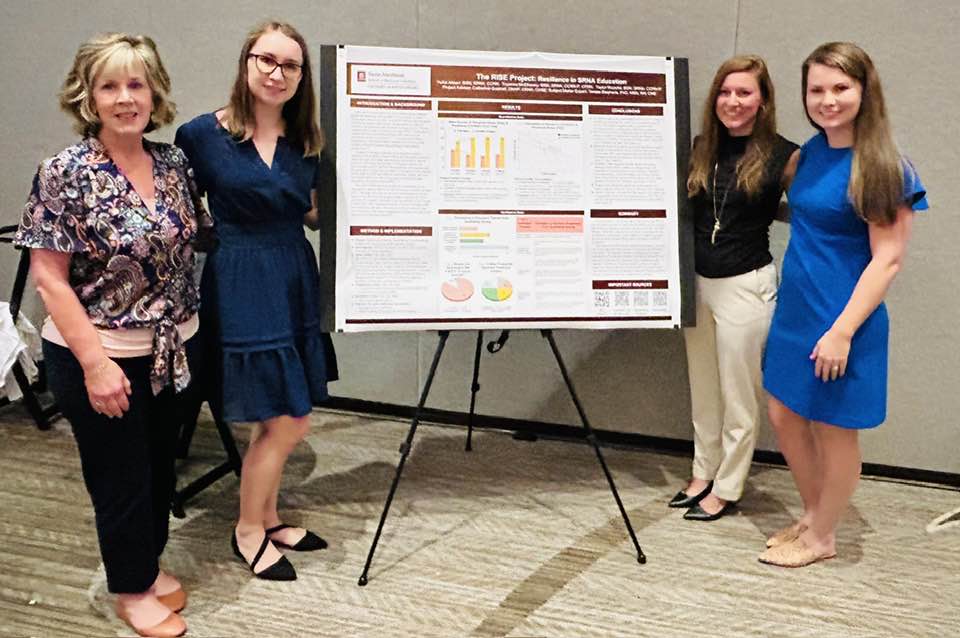
This past weekend I experienced one of the greatest honors AND milestones in my (almost) 20 years of RESILIENCE research and work. An amazing group of CRNA students utilized the RN P.R.E.P. program for their doctoral research project with impressive results (yes, statistical significance)! I was invited to attend their presentation at the CRNA Conference and was brought to tears hearing the impact of the course on the learners. A special thanks to Toy, Taylor, Yullia, and their wonderful faculty advisor, mentor Dr. Catherine Gutshall! It was such a joy working with all of them over the past year.
I look forward to working with this team to share the study via publication(s) and a future RN P.R.E.P. Podcast episode (stay tuned). Until then, please take a look at some pics from the event below.
Some Personal Perspective
One of the biggest life-lessons I’ve learned over the past 2 decades in researching NURSE RESILIENCE is that “TIME” is a critical component of change, especially culture change. If you’ve known me personally or heard me speak, you know I’m a believer in Rogers’ Diffusion of Innovations Theory which emphasizes the time-based element in the process of innovation. I have had to accept and (now) embrace this important fact……change takes time…..especially in nursing! This was a difficult “growing pain” for me as I tend to be very impatient with change, ha!
When I first began this work (almost 20 years ago), I was told it wasn’t “relevant” to nursing and that I should choose another focus for my research. However, I knew that it WAS very relevant and I just needed to prove that. It has not been an easy journey, by any means. In fact, I have met resistance at every step, mostly because my approach to teaching RESILIENCE is contrary to what many want to hear, especially those who are striving to maintain the status quo for personal gain.
RESILIENCE is never passive. In fact, based on my research and that of many others, it often includes active resistance to the status quo. This is critical in changing culture, especially those cultures where nurses experience chronic workplace stress (more about that soon) and where systems failures are not being addressed. Burnout is a systems issues requiring a systematic response. Resilience is a big part of that as it empowers the individual to regain control over their life and career to make informed decisions, choosing their response to the perceived stress and adversity.
I’m thankful that God put this work in my own life’s journey and am grateful for those who are carrying it to individuals and groups around the world!
“For such a time as this” Esther 4:14
Tese



 RN P.R.E.P.