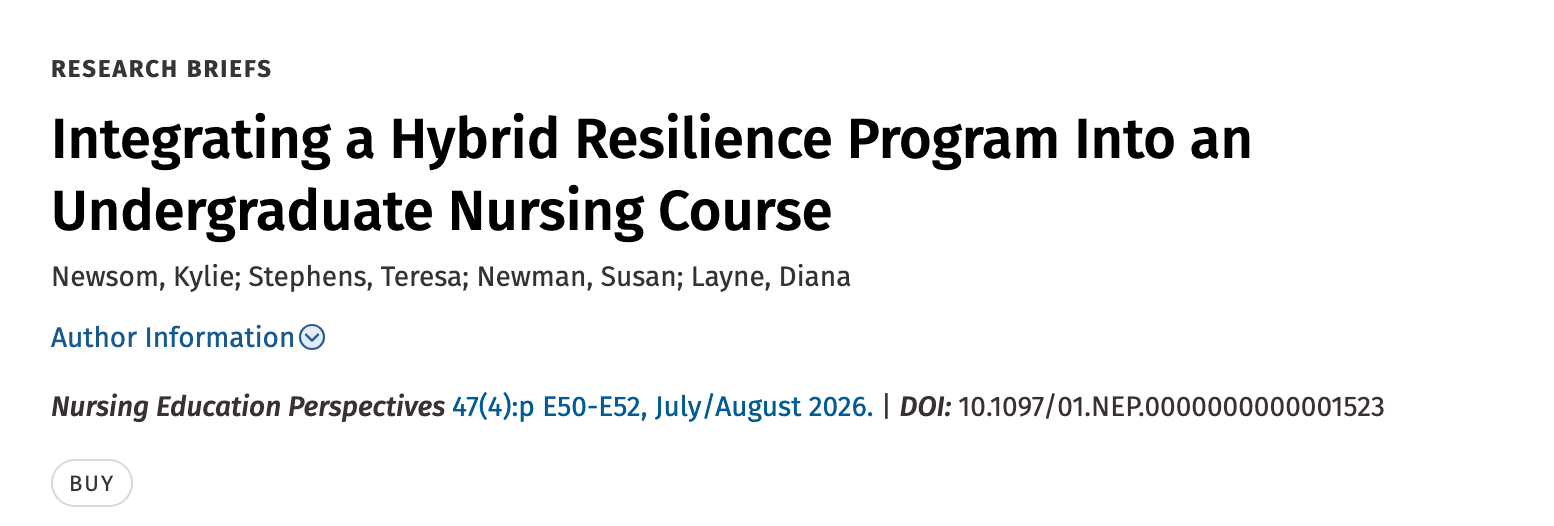
One of the greatest rewards of doctoral mentoring is watching students transform a research question into meaningful scholarship that advances nursing education. I am especially proud to celebrate the publication of a new article by my former PhD student, Dr. Kylie Newsom, whose dissertation research examined the feasibility of integrating RN P.R.E.P. into an undergraduate nursing curriculum. The study, just published in Nursing Education Perspectives, represents an important step in understanding how resilience education can be embedded into nursing programs to support student well-being and professional development.
Why Resilience Matters in Nursing Education
The nursing profession continues to grapple with unprecedented levels of stress, burnout, and workforce shortages. Evidence suggests that burnout begins long before nurses enter practice. Research cited in the article notes that up to 37% of nursing students experience symptoms of burnout before graduation. These findings reinforce what educators increasingly recognize: resilience cannot be treated as an optional skill—it is an essential competency.
The American Association of Colleges of Nursing (AACN) Essentials emphasize the importance of self-care, wellness, and professional formation. Yet many nursing programs continue to struggle with the practical question: How do we effectively teach resilience within an already crowded curriculum?
Sadly, the concept of resilience has been weaponized in nursing and healthcare, negatively impacting its full potential as an important component of professional fulfillment and flourishing. We’ll be deep-diving into the facts about the power of a “resilient mindset” (hint: its not just psychological) in future posts and podcast episodes.
Building on the Nursing Student Resilience Model
RN P.R.E.P. was developed from the Nursing Student Resilience Model, which I first introduced in 2013. Over the past decade, that model has informed multiple studies and projects focused on resilience, stress management, and professional development in nursing students and nurses. RN P.R.E.P. translates those concepts into a structured 12-week educational program featuring video-based learning, guided reflection, skill development exercises, and workbook activities.
Dr. Newsom’s dissertation explored whether a hybrid implementation model—combining faculty-facilitated classroom delivery with optional self-directed app-based learning—could successfully be integrated into an undergraduate nursing course.
Perhaps the most encouraging finding was that RN P.R.E.P. could be incorporated into an existing nursing course without disrupting instruction. Faculty delivered all resilience modules during scheduled class sessions, demonstrating 100% implementation fidelity. No additional technology support was required, and all students were given access to the learning platform.
These results suggest that resilience education can be woven into nursing curricula using existing course structures rather than requiring standalone courses or extensive faculty training.
The most significant contribution of this work may be its demonstration that resilience education is feasible, scalable, and adoptable within undergraduate nursing curricula. Faculty often cite time constraints and insufficient resources as barriers to resilience instruction. Dr. Newsom’s findings suggest that structured, evidence-informed programs such as RN P.R.E.P. can help overcome these barriers while providing students with practical tools for managing stress and building professional resilience.
The study also reinforces a larger message: resilience development should be viewed as part of professional identity formation rather than as a short-term intervention designed to eliminate stress. Building resilience is a developmental process that unfolds over time through reflection, practice, support, and purposeful learning.
A Proud Mentoring Moment
This publication represents the culmination of Dr. Newsom’s doctoral dissertation and an important addition to the growing body of scholarship on resilience education in nursing. As a mentor, it is deeply gratifying to see former students become scholars who contribute new knowledge to the profession.
Most importantly, this work advances our shared goal of preparing future nurses not only to succeed academically, but also to thrive personally and professionally in increasingly complex healthcare environments.
Citation
Newsom, K., Stephens, T., Newman, S., & Layne, D. (2026). Integrating a hybrid resilience program into an undergraduate nursing course. Nursing Education Perspectives, 47(4), E50–E52. [integratin…ce-program | PDF]


