There is a question I have come to believe every nurse, nurse leader, and healthcare professional must answer: What do you stand for?
Not what your organization stands for. Not what your supervisor values. Not what is popular, politically advantageous, or likely to earn approval.
What do you stand for?
Because if you do not know the answer to that question, someone else will answer it for you. And when that happens, burnout, moral distress, and moral injury are not far behind.
The Importance of Knowing Yourself
Self-awareness is often discussed as a leadership competency. We complete personality assessments, leadership inventories, and emotional intelligence exercises. While these tools can be useful, true self-awareness goes deeper.
Self-awareness means understanding:
· Your purpose
· Your priorities
· Your core values
· Your non-negotiables
· The principles you refuse to abandon, even under pressure
When stressful situations arise—and they always do—these become your compass.
Without that compass, it is easy to become lost in the expectations, demands, and agendas of others. The result is often subtle at first.
You begin making decisions based on what will avoid criticism. You start focusing on what people in power might want. You anticipate reactions instead of evaluating principles.
You ask: “Will this get me in trouble?” Rather than: “Is this the right thing to do?”
That shift may seem small. It is not. It changes everything.
The Hidden Cost of Leading from Fear
Many nurse leaders have been unintentionally imprinted to believe that their primary responsibility is to follow orders, maintain harmony, and avoid conflict.
Over time, this conditioning becomes normalized. Leaders learn to:
· Anticipate the wishes of those above them
· Avoid difficult conversations
· Suppress dissenting opinions
· Equate obedience with professionalism
· Prioritize approval over integrity
In these environments, compliance is often rewarded while courageous questioning is viewed as disruptive. But this is not leadership. It is adaptation to power. And while it may feel safer in the moment, it comes at a tremendous personal cost.
Every time we act against our values, remain silent when we should speak, or support decisions we know are harmful, we experience a form of ethical dissonance.
That dissonance accumulates. Eventually, it becomes exhaustion. Cynicism. Burnout. Or, in more severe cases, moral injury.
Moral Courage Requires Moral Clarity
You cannot demonstrate moral courage if you do not know your moral commitments.
Courage is not simply speaking up. Courage is speaking up for something.
That is why core values matter. When nurses know what they stand for, decisions become clearer. The question shifts from: “What do they want me to do?” to “How does this align with my values/ethics?”
Values and ethics become a filter through which decisions are evaluated.
For some nurses, patient advocacy is non-negotiable. For others, transparency, fairness, dignity, compassion, or justice serve as guiding principles. Whatever those values may be, they provide stability when organizational pressures threaten to pull us in another direction.
As the saying goes: If you do not stand for something, you will fall for anything.
A Question That Has Driven My Work for Two Decades
For more than twenty years, I have wrestled with a question that continues to trouble me: Why do good nurse leaders sometimes act in ways that conflict with their own ethics and values?
Throughout my career, I have met extraordinarily intelligent, compassionate, and dedicated leaders who genuinely cared about patients, staff, and the profession. Yet I repeatedly observed situations in which ethical principles seemed to yield to organizational pressures, political realities, hierarchical expectations, or fear.
The question was never simply why bad things happen. The question was why good people participate in them.
That question became one of the driving forces behind my research on resilience, moral courage, leadership, and the resilient mindset. As I explored the literature, I found myself drawn beyond healthcare and leadership studies into history, psychology, and ethics. In particular, I became interested in understanding the roles of perpetrators, bystanders, and resistors during the Holocaust.
What allows some individuals to participate in harmful systems? Why do others remain silent? And perhaps most importantly, what enables a minority of people to resist?
These questions led me to the work of political philosopher Hannah Arendt and her influential book, The Banality of Evil. Reporting on the trial of Adolf Eichmann, Arendt challenged the assumption that great evil is always committed by monstrous individuals. Instead, she suggested that profound harm can occur when ordinary people stop thinking critically about their actions and become absorbed in fulfilling roles, following procedures, obeying authority, or advancing organizational objectives.
Arendt’s insight was deeply unsettling because it shifted the conversation away from individual pathology and toward everyday behavior.
At its core, ethical behavior requires thinking. It requires the willingness to pause, reflect, question, and evaluate whether our actions align with our values.
When people stop thinking, they often begin operating on autopilot. They follow expectations rather than principles. They comply rather than reflect. They make decisions based on anticipated reactions rather than ethical convictions.
In healthcare, this dynamic often reveals itself in subtle ways. A leader asks, “What does administration want?” A manager wonders, “Will this get me into trouble?” A nurse hesitates to speak because challenging the status quo feels risky.
Over time, these small acts of self-censorship accumulate into something more significant: a culture where ethical responsibility is gradually replaced by organizational conformity. This is why self-awareness matters so deeply.
When leaders have not spent time clarifying their values, purpose, and non-negotiables, they become susceptible to external pressures and internal fears. Conversely, leaders who know what they stand for are more likely to recognize ethical conflicts when they emerge and more willing to act with courage despite the risks.
The lesson I have drawn from both my resilience research and my study of moral courage is surprisingly straightforward:
Resilience is not simply the capacity to endure hardship. It is the capacity to think clearly, remain anchored to one’s values, and act intentionally in the face of pressure.
Ultimately, the opposite of resilience is not weakness. The opposite of resilience is unthinking compliance. And the antidote begins with a simple but powerful act:
Knowing who you are, what you stand for, and what you are unwilling to surrender.
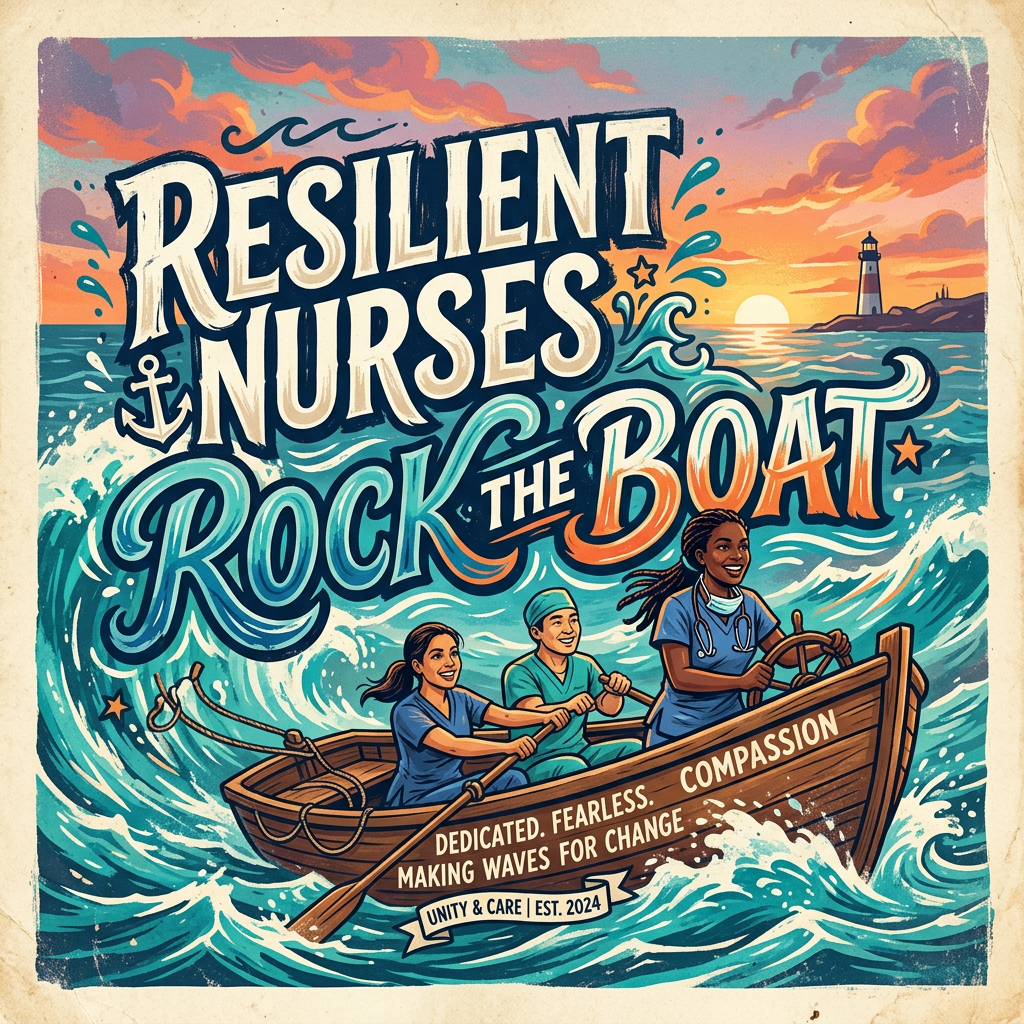
Resilient Nurses Rock the Boat
One of the greatest misunderstandings about resilience is the belief that resilience means endurance.
Many people define resilience as the ability to tolerate difficult circumstances without complaint. But that definition is incomplete—and potentially dangerous.
Resilience is not passive acceptance. Resilience is not silent suffering. Resilience is not learning to tolerate dysfunctional systems.
I describe resilience as: An informed, intentional response to stress and adversity, often leading to personal growth, increased ability to cope, and overall enhanced well-being.
Notice what is absent from that definition. There is no requirement to accept the status quo. There is no expectation of compliance. There is no mandate for silence.
In fact, truly resilient nurses often do the opposite. They ask difficult questions. They challenge assumptions. They identify harmful practices. They advocate for change. They refuse to confuse loyalty with obedience.
In many cases, resilient nurses are the people who rock the boat. Not because they enjoy conflict. But because they care too much to remain silent.
I call this COMPASSIONATE COURAGE.
The Link Between Resilience and Resistance
History reminds us that meaningful progress rarely occurs because people comfortably accept existing systems. Progress occurs because individuals are willing to challenge them. Healthcare is no exception.
Our profession’s greatest advances emerged because nurses questioned traditions, challenged harmful practices, and imagined better possibilities.
The same remains true today. If we hope to create healthier workplaces, reduce burnout, prevent moral injury, and improve patient outcomes, we must be willing to examine the cultures we have inherited. Some of those cultures are rooted in hierarchy. Some are rooted in fear. Some reward compliance more than critical thinking. Some unintentionally teach nurses that survival depends upon staying quiet.
These dynamics do not disappear on their own. They change when people have the courage to name them.
Purpose Protects Us
One of the most powerful protective factors against burnout and moral injury is a clear sense of purpose. Purpose provides perspective during difficult seasons. It reminds us why our work matters. It helps us distinguish between temporary discomfort and true ethical compromise.
When purpose is clear, it becomes easier to tolerate the discomfort that often accompanies courage.
You may not always know what the outcome will be. You may not always be successful. But you can remain aligned with who you are. And that alignment matters.
Because at the end of the day, resilience is not about avoiding adversity. It is about remaining connected to your values while navigating it.
A Reflection for Nurse Leaders
The most dangerous question a leader can ask is, “What will keep me out of trouble?’ The most important question is, “What is the right thing to do, and am I willing to do it?’”Take a moment and ask yourself:
· What are my core values?
· Which values are non-negotiable?
· What purpose guides my leadership?
· When was the last time I made a decision primarily from fear?
· What issue have I remained silent about even though it conflicts with my values?
· What would moral courage look like in that situation?
The answers may not be comfortable. But they may reveal exactly where growth is needed.
Final Thoughts
Burnout prevention is not only about self-care. Moral injury prevention is not only about wellness programs. Both require something deeper.
They require self-awareness and self-regulation.They require purpose. They require values and ethics. Most importantly, they require the courage to live consistently with what matters most.
The future of nursing will not be shaped by those who simply comply with existing systems. It will be shaped by nurses who are clear about their purpose, grounded in their values, and courageous enough to challenge what no longer serves patients, professionals, or the profession.
Because resilience is not passive acceptance. Resilience is the courage to remain true to your values—and to act on them—even when the boat starts to rock.


