
“There is a massive, untapped well of wisdom within people inside our organizations. It stays largely untapped for as long as we keep turning to each other when we get stuck.”
Those words, shared recently on LinkedIn by Helen Bevan in a discussion of organizational network analysis (ONA), should resonate deeply with nurses. Drawing on research highlighted by Richard Santos Lalleman and Rob Cross, Bevan points to a troubling reality: despite frequent calls for collaboration, empowerment, and distributed leadership, information and influence often remain concentrated among a remarkably small group of people.
In the example she discussed, the top two layers of leadership represented only 4% of the workforce yet absorbed approximately one-quarter of all requests for help. When those leaders needed help themselves, they turned to one another three times more often than to the broader workforce. Person for person, a senior leader was roughly 70 times more likely to be consulted than someone elsewhere in the organization.
Bevan describes the result as a “closed loop at the top”: leadership talking primarily to leadership.
For nursing, that observation feels profoundly familiar.
The Biggest Voice Missing from the Room
Nurses comprise the largest healthcare profession in the United States, with more than five million professionals serving patients, families, communities, and healthcare organizations every day. No profession spends more time with patients, sees more clearly how healthcare systems function in real time, or brings a broader perspective to the realities of care delivery.
Nurses understand workforce challenges, patient safety risks, operational inefficiencies, ethical tensions, care coordination barriers, and the human experience of healthcare. Yet nursing’s voice is still too often absent from the rooms where critical decisions are made.
Across healthcare systems and academic institutions, executives routinely identify nurse recruitment, retention, engagement, wellbeing, burnout, and workforce sustainability as urgent priorities. These issues shape board meetings, strategic planning, executive retreats, and budget conversations.
Ironically, the people most affected by these decisions—and often best equipped to help solve them—are not always included when decisions are made.
Decisions about nurse wellbeing are frequently made without nurses. Retention initiatives are designed without frontline nursing input. Faculty workload policies are developed without the faculty experiencing expanding (often unreasonable) expectations and responsibilities. Academic restructuring efforts often proceed without meaningful engagement from nurse educators.
In other words, organizations spend enormous time discussing how to fix nursing while too rarely asking nursing what needs to be fixed.
The result is predictable: when leadership talks primarily to leadership, organizations hear more of the same perspectives and miss the insight distributed throughout the workforce.
Leadership Talking to Leadership
The organizational network findings highlighted in Bevan’s post expose a common weakness in modern decision-making: when complex problems arise, leaders often seek answers from the same small circle of trusted voices.
Over time, influence concentrates, perspectives narrow, and blind spots become harder to see.
This is groupthink in action. A cohesive group, relying heavily on shared assumptions, begins to reinforce familiar interpretations while unintentionally discouraging dissenting or alternative perspectives. In healthcare, this can occur when executive teams discuss nursing challenges primarily with other executives, creating the impression of consensus while excluding those closest to the work. The issue is not a lack of commitment or good intentions; it is that closed decision-making networks can make incomplete understanding feel like alignment. When nurses, faculty, students, and frontline staff are absent from the conversation, an organization may believe it has fully examined an issue when it has only examined it from the perspective of those already at the table. (I discussed this at length in my article on “Cognitive Debiasing”.)
· Similar experiences lead to similar assumptions, causing important realities to be missed.
· Knowledge held by those closest to the work remains unrequested and unused.
· Decisions slow down because too much influence is funneled through too few leaders.
· Employees stop sharing ideas when they see little evidence that their insights shape meaningful change.
Healthcare organizations experience these consequences every day, especially when decisions about nursing are made without fully engaging nursing’s knowledge.
Who Has Your Ear?

A contemporary version of The Emperor’s New Clothes plays out in organizations more often than we may want to admit. No one intends to mislead. No one sets out to ignore reality. Yet leaders can become surrounded by voices that affirm the narrative already taking shape. Reports are filtered. Concerns are softened. Data are summarized until the lived experience behind them nearly disappears. People learn what is safe to say, what is rewarded, and what is quietly avoided. Eventually, an organization may find itself admiring a strategy, policy, or initiative that appears impressive from the executive suite while those closest to the work can plainly see what is missing.
That is why one of the most important questions a leader can ask is also one of the simplest: Who has your ear?
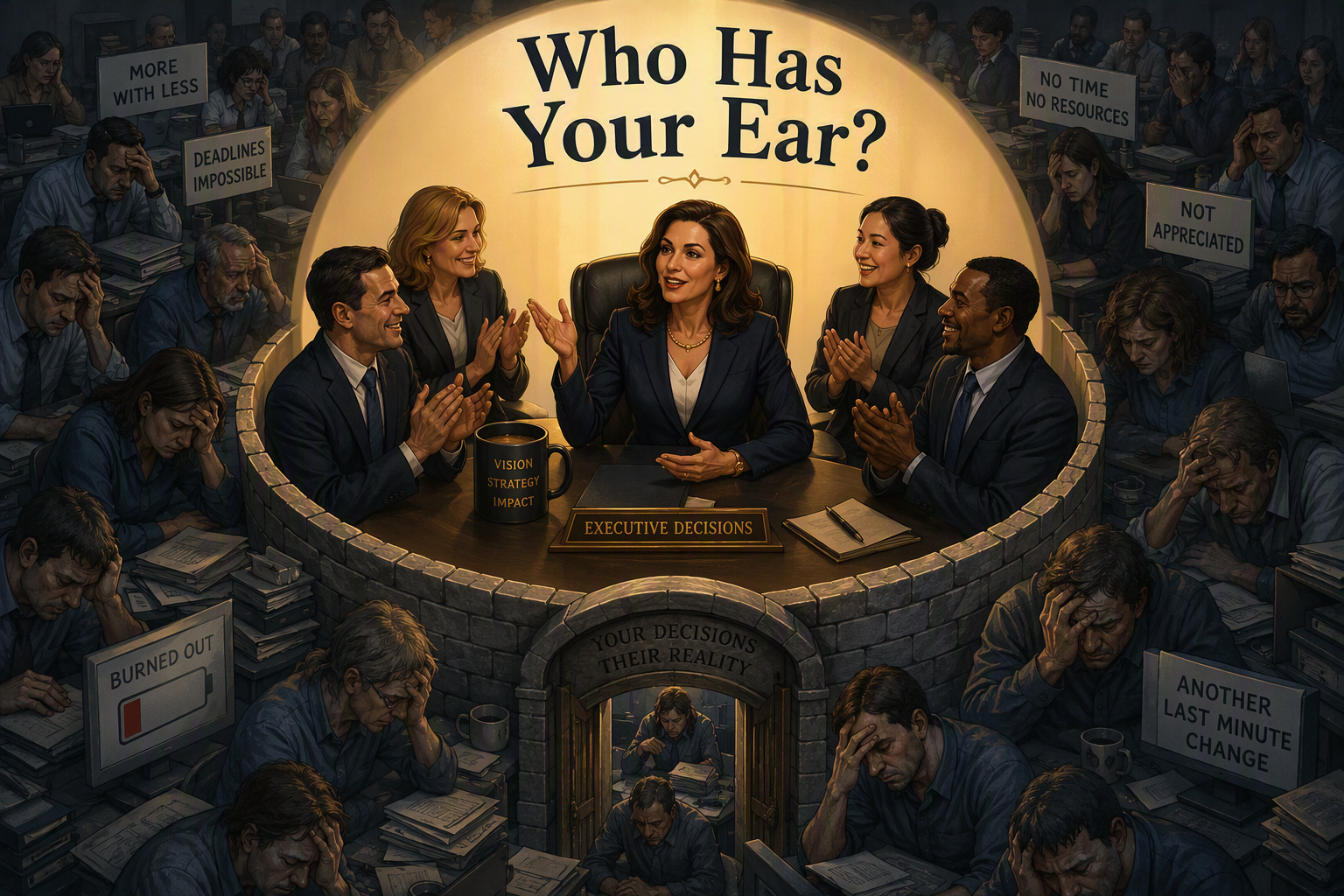
The question is not merely about access; it is about perspective. Who is shaping how you understand the problem? Who is helping you interpret the data? Who is close enough to the work to tell you what is actually happening, even when the truth is inconvenient? Who has the credibility, courage, and proximity to challenge assumptions before they become decisions?
In my resilient mindset model, this connects directly to the third P: Perspective. Resilient leaders do not make strong decisions simply because they are confident, experienced, or well-intentioned. They make stronger decisions because they actively seek informed perspective. They understand that proximity produces insight, polished summaries cannot replace firsthand knowledge, and the people most affected by a decision often hold the wisdom needed to improve it.
For executives, Who has your ear? is more than a reflective question; it is a leadership practice. It asks whether decision-making circles are broad enough, honest enough, and close enough to reality. It challenges leaders to examine whether they are relying on the same familiar voices or intentionally creating pathways for nurses, faculty, students, frontline staff, and informal leaders to influence the conversation. It also reminds organizations that the absence of disagreement is not always evidence of alignment. Sometimes it is evidence that the right people were never invited to speak.
Consider nurse retention, one of the challenges most often cited by healthcare executives. Organizations invest substantial time and resources studying why nurses leave, yet many of the answers already reside within the workforce itself.
Frontline nurses understand workload realities; nurse managers understand operational constraints; clinical educators understand competency gaps; experienced nurses understand the barriers that affect morale, engagement, and professional fulfillment; and faculty understand why colleagues experience burnout, moral distress, and consider leaving academia.
The wisdom already exists; the question is whether organizations are willing to listen.
The Hidden Organization in Nursing
One of the most compelling ideas in organizational network analysis is the presence of a “hidden organization”—the informal network of people who quietly move work forward, solve problems, share knowledge, and sustain momentum.
These networks rarely follow the organizational chart. The people who connect colleagues, spread information, mentor others, preserve culture, and keep complex work moving are often informal leaders whose influence far exceeds their title.
Healthcare is no exception. Every nursing unit has nurses people call when a difficult problem arises. Every school of nursing has faculty members who quietly connect colleagues, mentor peers, preserve culture, and solve problems behind the scenes. Every healthcare system has nurses who serve as trusted advisors even without formal authority.
Together, these individuals form the hidden infrastructure that keeps organizations functioning.
Nursing has always excelled at building and sustaining these informal networks. We coordinate across disciplines, bridge communication gaps, connect departments, translate strategy into action, and solve problems collaboratively.
In many ways, nursing itself is one of healthcare’s most powerful networks of collective intelligence.
The missed opportunity is that organizations too often make strategic decisions without recognizing, engaging, or leveraging this hidden infrastructure.
Why Resilient Teams Matter
For years, resilience has been framed largely as an individual responsibility.
Personal resilience initiatives, including my own RN P.R.E.P. program, teach nurses how to cope with stress, adapt to change, manage adversity, and reduce the risk of burnout. These skills matter. Individual resilience matters deeply.
But individual resilience alone cannot solve systemic problems. Workforce shortages, faculty shortages, moral distress, patient safety challenges, and professional disengagement are not individual failures; they are organizational challenges that require collective solutions.
That is why resilient teams matter.
Resilient teams create something individual resilience cannot: collective capacity. They transform isolated experiences into shared understanding, individual observations into organizational insight, concern into coordinated action, and individual voices into collective influence.
A resilient team sees what individuals alone may miss, challenges assumptions individuals may hesitate to question, and creates opportunities for innovation, advocacy, and transformation that would be impossible in isolation.
Resilient Teams Don’t Just Survive Systems. They Change Them.
Perhaps the greatest misconception about resilience is that it is primarily about endurance. Too often, resilience is framed as helping nurses tolerate increasingly difficult circumstances, recover from adversity, and continue functioning despite significant challenges.
But resilience has a far more powerful purpose: it is not merely the capacity to survive a system; it is the capacity to improve it.
Resilient teams possess what individual nurses often lack on their own: collective power. A single nurse may struggle to influence policy, but a united network of nurses can become impossible to ignore.
The organizational network analysis highlighted in Bevan’s post demonstrates how influence naturally concentrates among small groups of leaders. Resilient teams can disrupt that pattern by creating new pathways for influence, elevating frontline expertise, and ensuring nursing perspectives become part of organizational decision-making.
Rather than accepting exclusion from key discussions, resilient teams advocate for structural change. They insist that decisions affecting nursing include nursing, champion policies that require frontline representation, and elevate the expertise of clinicians, educators, researchers, and students whose perspectives are too often overlooked.
Most importantly, resilient teams shift nursing’s role from being the subject of decisions to becoming an architect of decisions.
From Subjects of Decisions to Architects of Decisions
For decades, nurses have too often been positioned as recipients of organizational decisions rather than co-creators of them.
A staffing model changes, a retention strategy is launched, a wellbeing initiative appears, a workload policy is revised, or an academic restructuring occurs—and then nursing is expected to adapt.
Resilient teams ask a different and more consequential question:
Why weren’t nurses involved in designing this from the beginning?
That question changes the work from adaptation to influence.
If recruitment, retention, clinician wellbeing, faculty engagement, and patient outcomes are strategic priorities, nurses must help design the strategies, policies, workload expectations, resource decisions, and care-delivery models that shape those outcomes.
Those closest to the work must have meaningful influence over how the work is organized, supported, measured, and improved.
Anything less is a missed opportunity for better decisions, stronger systems, and improved outcomes.
Advocacy as a Collective Act
Historically, nursing’s greatest achievements have emerged not from individual heroics, but from collective action.
Safe staffing initiatives, workplace violence protections, professional practice standards, advanced practice authority, patient safety movements, educational reform, legislative advocacy, and health policy advancement all reflect what becomes possible when nurses organize around shared purpose and priorities.
None of these achievements occurred simply because individual nurses became more resilient.
They occurred because nurses united around shared values, ethical commitments, and collective priorities—and transformed resilience into advocacy.
Advocacy is often viewed as something that occurs primarily through professional organizations or legislative efforts. In reality, advocacy happens anytime nurses collectively influence decisions.
That influence belongs in professional associations, shared governance councils, faculty senates, accreditation bodies, boards of trustees, executive leadership teams, community partnerships, regulatory agencies, and the policy spaces where healthcare priorities are shaped.
And yes, nursing’s collective voice belongs in local, state, and national elections, where policies are shaped, priorities are set, and the future of healthcare is influenced.
Each of these spaces gives resilient teams an opportunity to amplify nursing’s collective voice and translate professional wisdom into meaningful influence.
Building Influence Through Collective Intelligence
A central message in Bevan’s discussion is that organizations already possess a vast reservoir of wisdom, yet too often fail to engage the people closest to the work.
Nursing represents one of healthcare’s largest reservoirs of untapped organizational intelligence. Imagine what more than five million nurses collectively know about patient care, workforce wellbeing, safety, ethics, quality, efficiency, and organizational culture—and how many solutions remain hidden when that knowledge is not fully invited into decision-making.
When nurses operate as isolated individuals, this wisdom remains fragmented. When nurses function as resilient teams, individual experiences become shared understanding, shared understanding becomes collective intelligence, collective intelligence becomes influence, influence becomes policy, and policy becomes systemic change.
A Personal Reflection: Why Resilient Teams Matter
Much of my work in resilience over the past decade has been grounded in a simple but powerful belief: resilient individuals can survive difficult systems, but resilient teams can transform them, creating the conditions for nurses not merely to endure, but to flourish.
When I first began studying resilience, I focused primarily on how individuals navigate adversity, recover from setbacks, and maintain purpose amid significant challenges. Those questions contributed to the development and evolution of the RN P.R.E.P. Program and to years of work supporting nurses, students, faculty, and leaders in strengthening resilience.
Over time, however, I became increasingly convinced that many of nursing’s most pressing challenges cannot be solved through individual resilience alone. Workforce shortages, ineffective policies, exclusion from decision-making, and the absence of nursing’s voice in key leadership spaces are organizational and systemic challenges that require collective solutions.
As a result, my work has increasingly shifted from helping individuals become more resilient to helping teams develop the collective capacity to influence culture, shape policy, and create meaningful change.
Through workshops, leadership programs, consulting engagements, and educational initiatives, I have repeatedly witnessed what happens when people begin to see themselves not merely as colleagues, employees, or committee members, but as resilient teams capable of transforming their environments.
When people move from asking, “How do we survive this?” to “How do we improve this?” something remarkable happens: they discover collective agency, collective courage, and collective influence.
Most importantly, they discover that meaningful change rarely begins with a single heroic leader. It begins when committed people unite around a shared purpose and refuse to accept the status quo as inevitable.
For nursing, this is especially important. Our profession does not lack expertise, ideas, or solutions. What we often lack are structures that fully leverage our collective wisdom.
That is why resilient teams matter: not simply because they help us cope with change, but because they help us create it.
The Impossible Becomes Possible
The history of nursing demonstrates that our greatest achievements have never been the product of isolated leaders. They have emerged from resilient teams united by shared purpose, mutual trust, professional commitment, and a determination to improve the human condition.
Today, healthcare faces unprecedented challenges: workforce shortages, burnout, faculty scarcity, increasing complexity, ethical tension, and financial pressures.
No single leader, executive team, or profession can solve these problems alone. But resilient teams can accomplish extraordinary things.
The organizational network analysis that inspired this discussion reminds us that organizations often overlook their greatest asset: the collective wisdom already present within their workforce. Nursing represents one of the deepest reservoirs of that wisdom.
More than five million nurses bring expertise, insight, creativity, courage, and practical knowledge to healthcare’s most pressing challenges. Yet too often, decisions about nursing, wellbeing, retention, and engagement are made without fully engaging nurses themselves.
The work ahead is clear. The question is not whether nurses have valuable contributions to make; the question is whether organizations are willing to create structures that allow nursing’s collective voice to be heard—and whether resilient nursing teams are willing to insist on being heard.
Because resilience is not merely about surviving difficult circumstances; it is about harnessing collective strength to transform them.
I have been blessed to witness this again and again: when resilient nursing teams organize, advocate, influence policy, and claim their rightful place at decision-making tables, they become far more than support systems. They become forces for change.
Together, they accomplish what others believe is impossible.
Looking Ahead
Over the years, participants in my resilience workshops have often encouraged me to take these ideas beyond the classroom and workshop setting and share them in book form. The question I hear most often is simple:
“When will there be a book?”
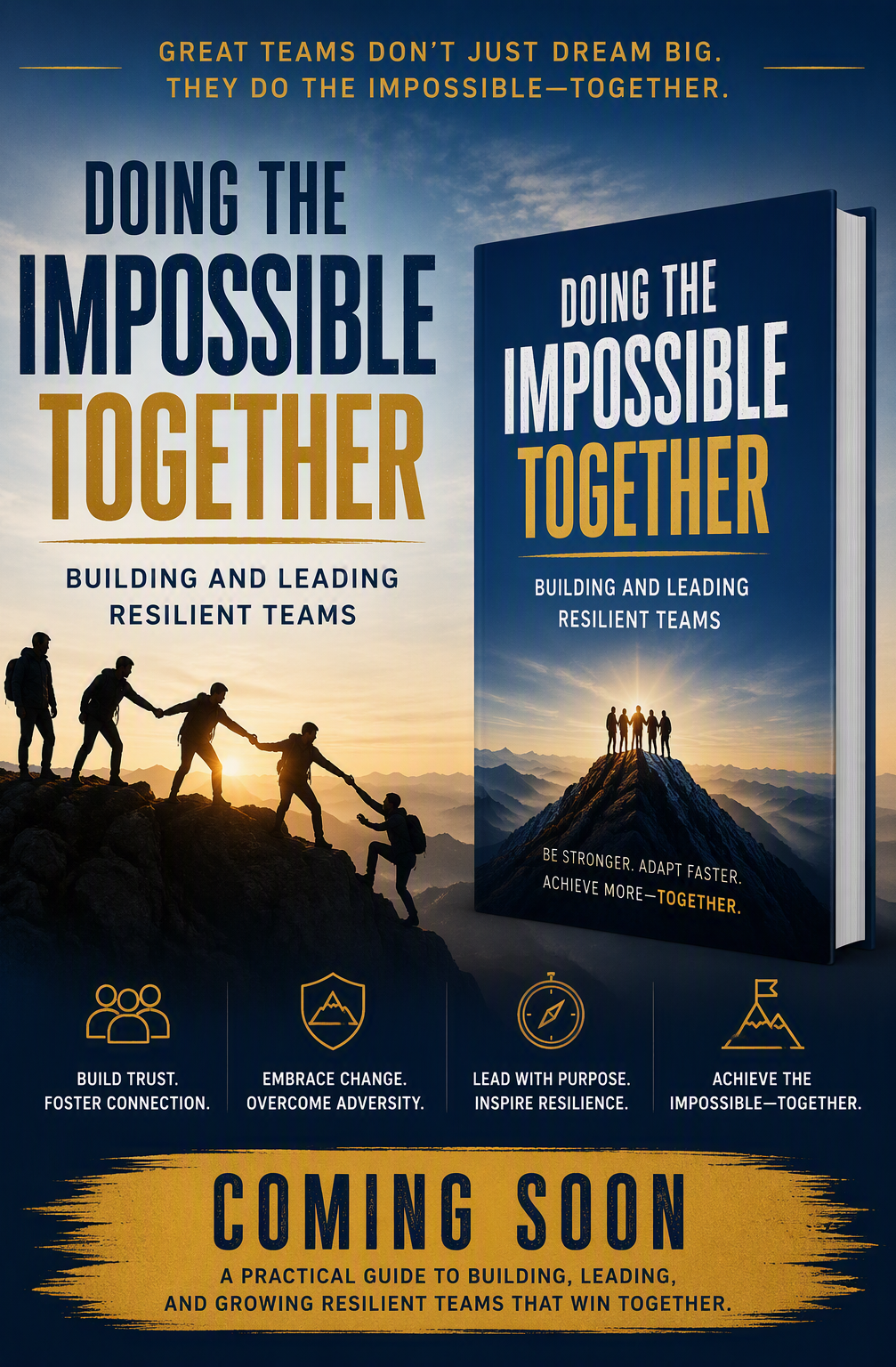
I am pleased to share that, after years of development, writing, refinement, and learning alongside extraordinary nurses and healthcare leaders, that project is nearing completion.
My upcoming book, Doing the Impossible (Together): Building and Leading Resilient Teams, expands on many of the concepts explored here, including collective resilience, shared leadership, psychological safety, resilience culture, collective agency, and the power of resilient teams to influence systems and create lasting change.
At its core, the book reflects a belief that has emerged again and again throughout my work: resilience is not only about helping individuals withstand adversity; it is about helping groups of people work together to improve the environments in which they live, learn, lead, and serve.
My hope is that it offers practical tools, evidence-informed strategies, and a renewed vision for resilience as a force for collective action and system transformation.
The manuscript is now in its final stages and should be available on Amazon soon.
I look forward to sharing more soon.
Onward! Together!


